API Academy
🌐 English
  • 🌐 English
  • 🌐 繁體中文
HomePetstore APIExplore more APIs
🌐 English
  • 🌐 English
  • 🌐 繁體中文
🌐 English
  • 🌐 English
  • 🌐 繁體中文
  1. API Tools
  • Introduction
  • Table of Contents
  • API Academy
    • Get Started
      • What is an API?
      • How Does an API Work?
      • How to Call an API?
      • How to Read an API Documentation?
      • Chapter Summary
      • Get realtime weather
    • API Fundamentals
      • API Funtamentals: Overview
      • Method & Path
      • Parameters
      • Request Body
      • Responses
      • API Specification & OAS
      • Chapter Summary
    • Working with APIs
      • Working with APIs: Overview
      • Making Requests from Spec
      • Environments and Variables
      • Chaining Multiple Endpoints
      • Handling Authentication
      • Handling API Signatures
      • Introduction to Scripts
      • Chapter Summary
    • Mocking APIs
      • Mocking APIs: Overview
      • Smart Mock
      • Mock Expectations
      • Cloud Mock
      • Mock Scripts
      • Chapter Summary
    • Designing APIs
      • Designing APIs: Overview
      • Introduction to API Design
      • Creating Your First API Project
      • Analyzing Requirements and Planning Your API
      • Designing Data Models
      • Designing Endpoints
      • Using Components and Reusability
      • Setting Up Authentication
      • API Design Guidelines
      • Chapter Summary
    • Developing APIs
      • Developing APIs: Overview
      • Setup: Install Your AI Coding Assistant
      • Quick Start: From Spec to Running API in 30 Minutes
      • Understanding the Generated Code
      • Testing Your API with Apidog
      • Deployment: Put Your API Online
      • Chapter Summary
    • Testing APIs
      • Testing APIs: Overview
      • Getting Started: Your First Test Scenario
      • Integration Testing and Data Passing
      • Dynamic Values
      • Assertions and Validations
      • Flow Control: If, For, ForEach
      • Data-Driven Testing
      • Performance Testing
      • Test Reports and Analysis
      • CI/CD Integration
      • Scheduled Tasks and Automation
      • Advanced Testing Strategies
      • Chapter Summary
    • API Documentations
      • API Documentations: Overview
      • Publishing Your First API Doc
      • Customizing Documentation Appearance
      • Interactive Features for Consumers
      • Advanced Publishing Settings
      • Managing API Versions
      • Chapter Summary
    • Advanced API Technologies
      • API Technologies: Overview
      • GraphQL
      • gRPC
      • WebSocket
      • Socket.IO
      • Server-Sent Events (SSE)
      • SOAP
      • Chapter Summary
    • API Lifecycle
      • API Lifecycle: Overview
      • Stages of the API Lifecycle
      • API Governance
      • API Security Best Practices
      • Monitoring and Analytics
      • API Versioning Strategies
      • The Future of APIs
      • Chapter Summary
    • API Security
      • API Security: Overview
      • API Security Fundamentals
      • Authentication vs Authorization
      • Understanding OAuth 2.0 and OpenID Connect
      • JSON Web Tokens (JWT)
      • OWASP API Security Top 10
      • Encryption and HTTPS
      • Chapter Summary
    • API Tools
      • API Tools: Overview
      • The Evolution of API Tools
      • API Clients
      • Command Line Tools (cURL, HTTPie)
      • API Design and Documentation Tools
      • API Mocking Tools
      • API Testing Tools
      • All-in-One API Platforms
      • Chapter Summary
    • API Gateway
      • API Gateway: Overview
      • What is an API Gateway?
      • Key Features of API Gateways
      • API Gateway vs Load Balancer vs Service Mesh
      • Popular API Gateway Solutions
      • The BFF (Backend for Frontend) Pattern
      • Chapter Summary
  • Modern Pet Store
    • Pet
      • Get Pet
      • Update Pet
      • Delete Pet
      • Create Pet
      • List Pets
      • Upload Pet Image
    • User
      • Update User
      • Get User
      • Delete User
      • Login
      • Logout
      • Create User
    • Store
      • List Inventory
      • Create Order
      • Get Order
      • Delete Order
      • Callback Example
      • Pay for an Order
    • Payments
      • Pay Order
    • Chat
      • Create Chat Completion
    • Webhooks
      • Pet Adopted Event
      • New Pet Available Event
  • Schemas
    • Pet
    • Category
    • User
    • ApiResponse
    • OrderPayment
    • Tag
    • Order
    • Links-Order
    • PetCollection
    • Bank Card
    • Bank Account
    • Links
    • Error
HomePetstore APIExplore more APIs
🌐 English
  • 🌐 English
  • 🌐 繁體中文
🌐 English
  • 🌐 English
  • 🌐 繁體中文
  1. API Tools

API Testing Tools

Testing is the backbone of reliable APIs. While Postman and Apidog handle functional testing (checking if 200 OK is returned), you often need specialized tools for Performance/Load Testing and Automated Regression Testing.

1. Apache JMeter (The Classic)#

Official Website: https://jmeter.apache.org/
The granddaddy of load testing.
Screenshot:
Apache JMeter Interface
JMeter's tree-based GUI. It looks functional but dated.
Type: Functional & Load Testing.
Strengths: Infinite configurability. It can simulate thousands of users using threads (Java).
Weaknesses: High learning curve. The GUI is "retro". Consumes a lot of memory for massive loads.

2. k6 (The Modern Standard)#

Official Website: https://k6.io/
A modern, developer-first load testing tool acquired by Grafana.
Type: Load Testing (CLI).
How it works: You write tests in JavaScript.
Strengths: Scriptable, version-controllable (Git), and extremely high performance (written in Go).
Weaknesses: No built-in GUI (results are often sent to Grafana).

3. Gatling#

Official Website: https://gatling.io/
Another heavyweight champion for performance.
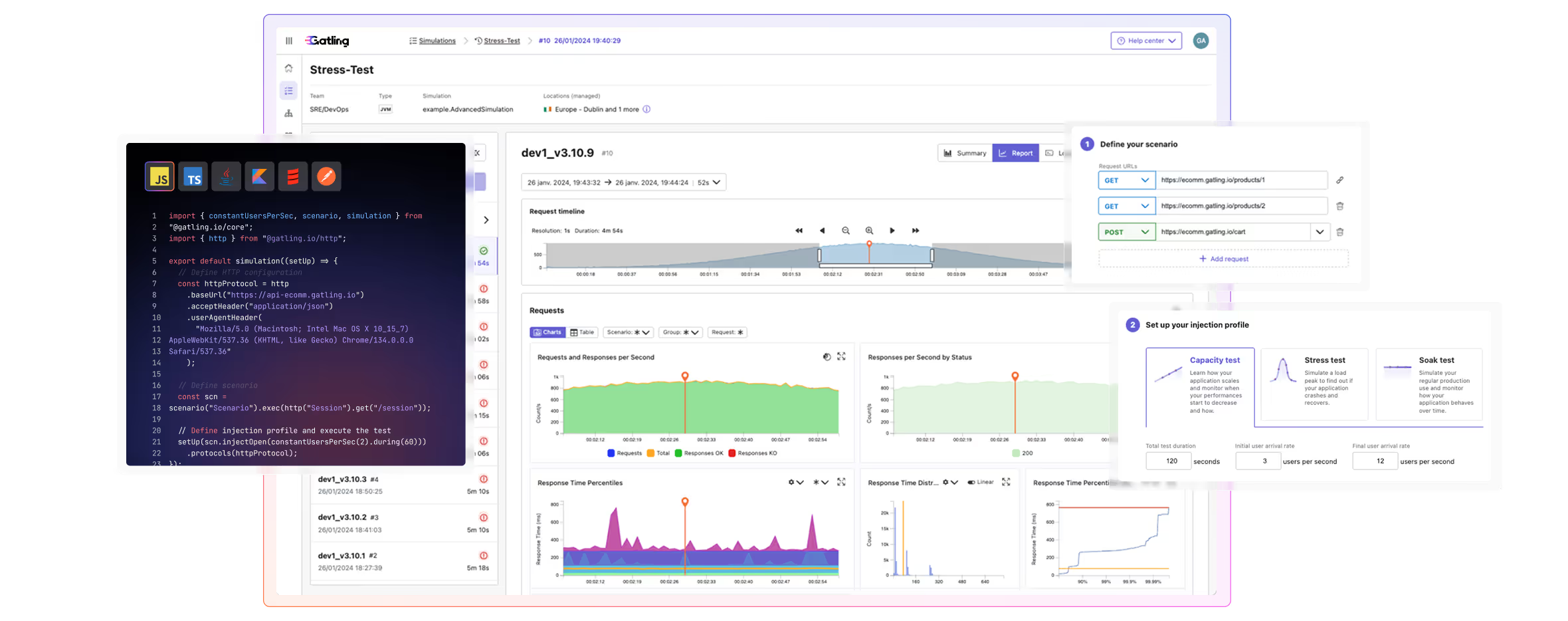
Screenshot:
Gatling Report
Gatling is famous for its detailed HTML reports generated automatically after a run.
Type: Load Testing (Code-based).
Language: Scala / Java / Kotlin.
Best For: Complex, high-scale scenarios where you need to simulate realistic user journeys.

4. REST Assured (The Code Choice)#

Official Website: https://rest-assured.io/
If you are a Java developer, this isn't a "tool" but a library you import.
Type: Functional Automation.
How it works:
Best For: Integrating API tests directly into your JUnit/TestNG test pipelines.

5. Apidog (Unified Testing)#

Official Website: https://apidog.com/
We mention Apidog again here because it bridges the gap.
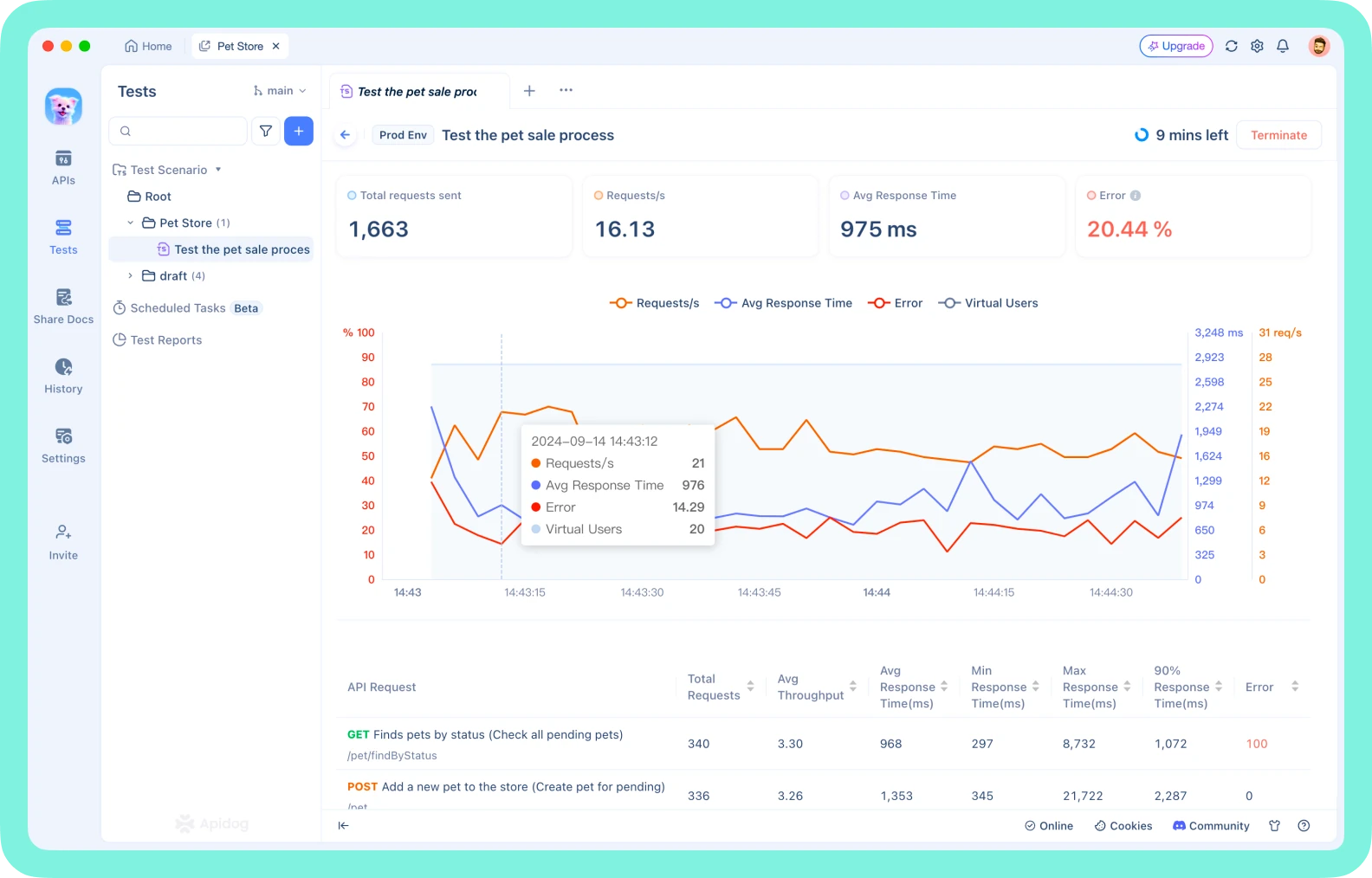
Screenshot:
Apidog Testing Interface
Capabilities:
Functional Testing: Like Postman's Runner.
CI/CD: Generates a command-line utility to run tests in Jenkins/GitHub Actions.
Visual Assertions: You don't need to write code to check if status == 200. You just click options.

Comparison Summary#

ToolTypeKey StrengthCode Required?Rating
k6PerformanceModern JS scriptingYes (JS)⭐⭐⭐⭐⭐
ApidogFunctionalVisual + IntegratedNo (GUI)⭐⭐⭐⭐⭐
JMeterPerformanceMassive Scale (Threads)No (GUI)⭐⭐⭐⭐
GatlingPerformanceDetailed ReportsYes (Java/Scala)⭐⭐⭐⭐
REST AssuredAutomationJava IntegrationYes (Java)⭐⭐⭐

Recommendation#

For Load Testing: Use k6. It's modern, lightweight, and developers love writing tests in JS.
For Functional/Regression Testing: Use Apidog to reuse your design specs as test cases without rewriting them.
For Java Shops: Use REST Assured to keep tests alongside your application code.

Key Takeaways#

Functional Testing checks strict correctness (Apidog, REST Assured).
Load Testing checks performance under pressure (k6, JMeter).
The future of testing is Code-First (k6) or Integrated (Apidog).
Next Step: Tired of juggling 5 different tools? Discover the solution in All-in-One API Platforms.
Modified atΒ 2025-12-29 10:42:25
Previous
API Mocking Tools
Next
All-in-One API Platforms
Built with